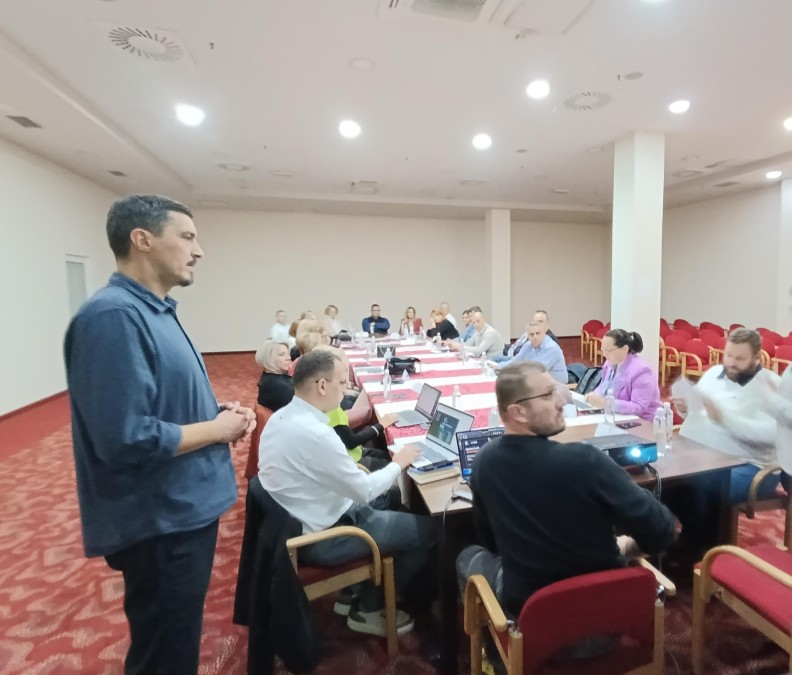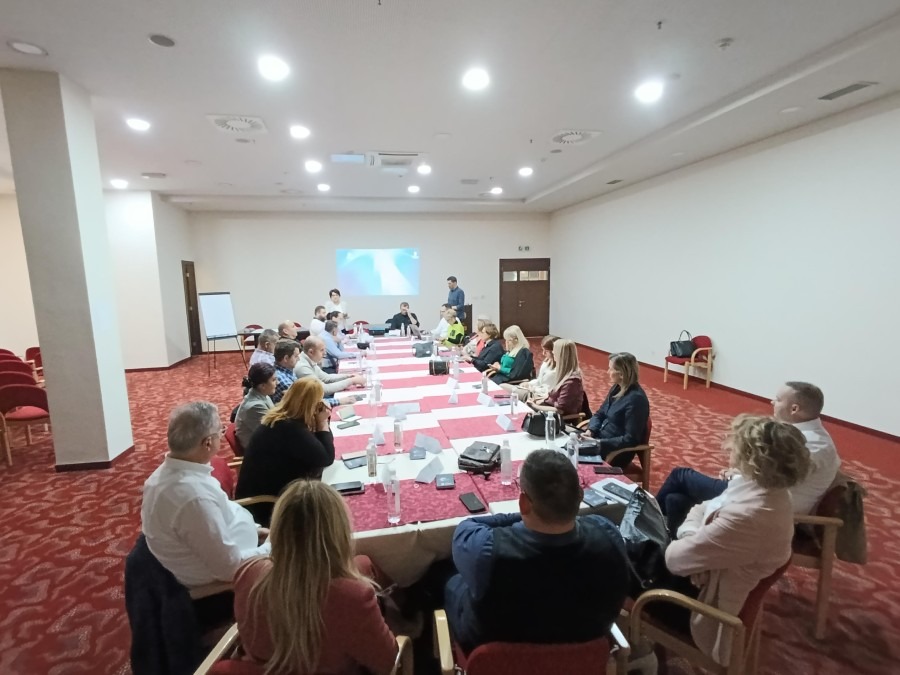
Zenica, 15 October 2025 – As part of the project “Strengthening the System of Secondary Vocational Education in Bosnia and Herzegovina,” the second meeting of the Advisory Council was held in Zenica. The meeting brought together key stakeholders in vocational education with the objective of sharing information, planning future activities, and strengthening institutional cooperation.
The meeting was attended by representatives of cantonal ministries of education, the Department of Education of the Government of Brčko District, the Pedagogical Institute, and a representative of the Ministry of Education of the Slovak Republic, Mr. Karol Jakubik.
The meeting was opened by Mrs. Efka Heder, project team leader, and Mrs. Žaneta Džumhur, Chairperson of the Advisory Council.
Exchange of Experiences and Good Practices
A special contribution was made by Mr. Karol Jakubik, representative of the Ministry of Education of the Slovak Republic, who presented the Slovak experience in the establishment and functioning of Centers of Excellence in vocational education, with a focus on the legislative framework that enables their sustainable operation.
In this context, the possibility of establishing bilateral cooperation between educational institutions in BiH and the Slovak Republic was emphasized, both at the institutional level (ministries and pedagogical institutes) and at the school level, including within centers of excellence. Such cooperation would include collegial learning, knowledge exchange, and the transfer of best practices.
Presentation of Digital Tools and Previous Results
Rizah Kabaši, a representative of SmartLab, presented the Community of Practice (CoP) platform—a digital tool for professional communication, information exchange, and collegial learning among vocational education stakeholders.
Presentation of Achievements and Next Steps
Eldin Sarajlić, Key Expert for Project Management in Vocational Education, informed participants about the results achieved so far and ongoing project activities, and outlined the following next steps:
- Harmonization of Legislation: A joint initiative by cantonal ministries of education to amend the Law on Income Tax and the Law on Contributions of the Federation, in order to create a stimulating legal and fiscal framework for employers who include students in work-based learning programs.
- Quality Assurance: Strengthening school capacities for self-assessment in line with European standards (EQAVET), and developing policies based on collected and analyzed data.
- Digital Support for Learning: Implementation of the Cep platform as a tool for ongoing professional exchange and learning.
- Continuous Professional Development of Teachers: Improving teachers’ competencies through professional courses delivered in companies, enabling teachers to update their knowledge in line with modern technical and technological developments.
- Mentor Training: Identifying training needs for company mentors and master mentors.
- Establishment of Centers of Excellence: Defining models and the legal framework for the development of these key institutions.
- Cost-Benefit Analysis: Conducting research on the economic aspects of work-based learning in companies.
- Regulation of Student Status: Initiative to include the status of students involved in practical training in the labor legislation of the Federation.
- Digital Registry of Companies: Creating a registry of companies that provide work-based learning opportunities.
- Repository of Legal Regulations: Developing a comprehensive database of regulations relevant to vocational education in BiH, to assist educational authorities in drafting legal and sub-legal acts, drawing on the experiences of administrative units that have already undertaken such work.
This meeting reaffirmed the commitment of all stakeholders to work together towards the advancement of vocational education in Bosnia and Herzegovina.